

What Should a Professional Business Website Include?

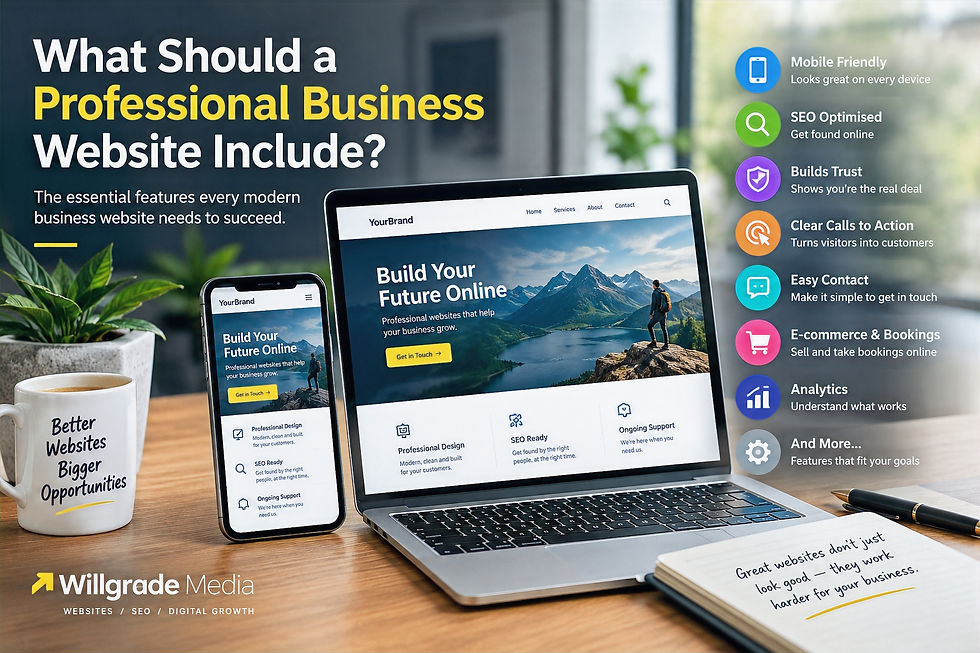
A professional business website needs to do more than look good.
It should explain what your business does, make it easy for potential customers to take the next step, work properly on mobile devices, and give search engines and AI systems enough clear information to understand your business.
The exact features you need depend on what your business does, but there are some essentials that almost every professional business website should consider.
What Should a Professional Business Website Include?
At a minimum, a good business website should provide:
Clear information about your business
Easy navigation
Professional and useful content
Mobile-friendly design
Strong calls to action
Contact and enquiry options
Basic SEO
Trust and credibility signals
Analytics
Appropriate security and accessibility
More advanced businesses may also need e-commerce, online booking, payments, customer accounts, automation or bespoke digital tools.
The important thing is to build the website around what your business needs to achieve, rather than simply adding features because they are available.
Clear Information About Your Business
Visitors should be able to understand what you do very quickly.
Your website should make it clear:
What your business does
Who you help
What products or services you provide
Where you operate
Why customers should choose you
How people can contact you
Avoid making visitors search through several pages to work out what you actually offer.
Your homepage should communicate the essentials clearly, with more detailed information available on relevant service or product pages.
A Website That Works on Mobile
A professional website needs to work properly across different screen sizes.
That means checking:
Text size
Navigation
Buttons
Images
Forms
Page spacing
Loading performance
Content layout
A website that looks excellent on a desktop computer but is difficult to use on a phone isn't doing its job properly.
Responsive design is therefore one of the fundamental parts of modern website design. Wix also identifies responsiveness and mobile-friendly design among the important features of a professional website.
Strong Calls to Action
A visitor shouldn't have to guess what to do next.
Depending on your business, your calls to action might be:
Get a quote
Contact us
Book an appointment
Buy now
Request a callback
Download a guide
Make an enquiry
The right call to action depends on the purpose of the page.
For example, a service page might encourage someone to request a quote, while an e-commerce product page should make purchasing straightforward.
Professional Website Content
Good design can attract attention, but content helps turn that attention into action.
Your website should explain your services in language your customers understand.
Useful content can include:
Service descriptions
Product information
Pricing guidance
Frequently asked questions
Case studies
Customer testimonials
About information
Contact details
Helpful guides and articles
Good content can also help your website appear for relevant searches because it gives search engines more information about the subjects your business covers.
SEO Built Into the Website
SEO shouldn't be something added after the website has already been built.
Basic SEO should be considered during the design and content process.
This can include:
Relevant page titles
Useful meta descriptions
Logical heading structure
Search-focused page content
Internal links
Image optimisation
Clean URLs
Appropriate structured data
Good mobile usability
Structured data can also help Google understand what a page is about, although it doesn't guarantee that enhanced search features will appear.
SEO doesn't mean filling a page with keywords. The aim is to make the website genuinely useful while making its subject and purpose clear.
Trust and Credibility
Before contacting a business, potential customers often want reassurance that they're dealing with a legitimate and professional company.
Your website can build trust through:
Genuine customer testimonials
Case studies
Client logos where appropriate
Professional photography
Clear contact information
Company information
Industry experience
Accreditations or qualifications where relevant
Links to genuine social profiles
Secure website technology
The amount of trust information you need will depend on your industry.
A local tradesperson, professional service provider and online retailer may all need different types of reassurance.
Contact Forms and Enquiry Options
Making contact should be easy.
Depending on your business, your website might include:
Contact forms
Email links
Telephone numbers
Booking forms
Online calendars
Live chat
Quote forms
WhatsApp or other messaging options
Don't make visitors hunt for your contact details.
If generating enquiries is one of the main purposes of your website, the contact process should be obvious and straightforward.
Online Booking and Payments
Some businesses need more than a standard contact form.
If you take appointments, your website may benefit from online booking functionality that allows customers to:
See availability
Choose a service
Select a time
Enter their details
Pay online where appropriate
Receive confirmation
This can reduce administration and make the customer journey much easier.
Similarly, businesses selling products may need integrated online payments and e-commerce functionality.
E-commerce Functionality
If you're selling products online, your website needs to support the entire customer journey.
This could include:
Product pages
Product categories
Shopping carts
Secure payments
Delivery options
Stock management
Customer accounts
Order notifications
Product search
Returns information
The complexity can vary dramatically.
Selling a small number of products is very different from operating a large online shop with hundreds of products and multiple delivery options.
Website Analytics
A professional website shouldn't just sit online without telling you what's happening.
Analytics can help you understand:
How many people visit
Which pages they view
Where visitors come from
Which devices they use
Which pages generate enquiries
What content attracts attention
This information can help you make better decisions about future improvements.
You don't need to become a data analyst. Even basic information can reveal which parts of your website are working and which may need attention.
What About Bespoke Digital Tools?
Not every business needs custom development.
However, some businesses have processes that could be improved through technology.
Examples include:
Automated quotation systems
Business calculators
Customer portals
Bespoke forms
AI-powered tools
CRM integrations
Automated workflows
Internal business tools
At that point, you're moving beyond a conventional business website and towards a bespoke digital solution.
The right solution might still be built around a website platform such as Wix, while connecting additional functionality where required.
How Much Does a Professional Business Website Cost?
There isn't one standard price.
A simple professional website may cost considerably less than a complex e-commerce website or a project involving bespoke functionality.
The final cost can depend on:
Number of pages
Design requirements
Content creation
SEO requirements
E-commerce
Online booking
Integrations
Automation
Bespoke functionality
Photography and graphics
Ongoing support
For a broader look at UK website pricing, see our guide:
How Much Does a Small Business Website Cost in the UK?
What Should Your Business Website Achieve?
Before deciding which features to include, think about what you actually want the website to accomplish.
For example, your main goal might be to:
Generate enquiries
Sell products
Take bookings
Showcase your work
Build credibility
Collect leads
Provide information
Reduce administration
Automate part of your business
Once you know the goal, choosing the right features becomes much easier.
You don't necessarily need the biggest or most complicated website.
You need a website that works for your business and your customers.
At Willgrade Media, we design and build professional Wix websites for businesses, with SEO, content, e-commerce, online booking and bespoke digital solutions available depending on the project.
If you're not sure what your business website needs, you can use our Instant Online Quote to get a starting point without obligation.
You can also find out more about our Wix Website Design & Build service.


Comments