

How Online Booking and Payment Systems Can Improve a Business Website

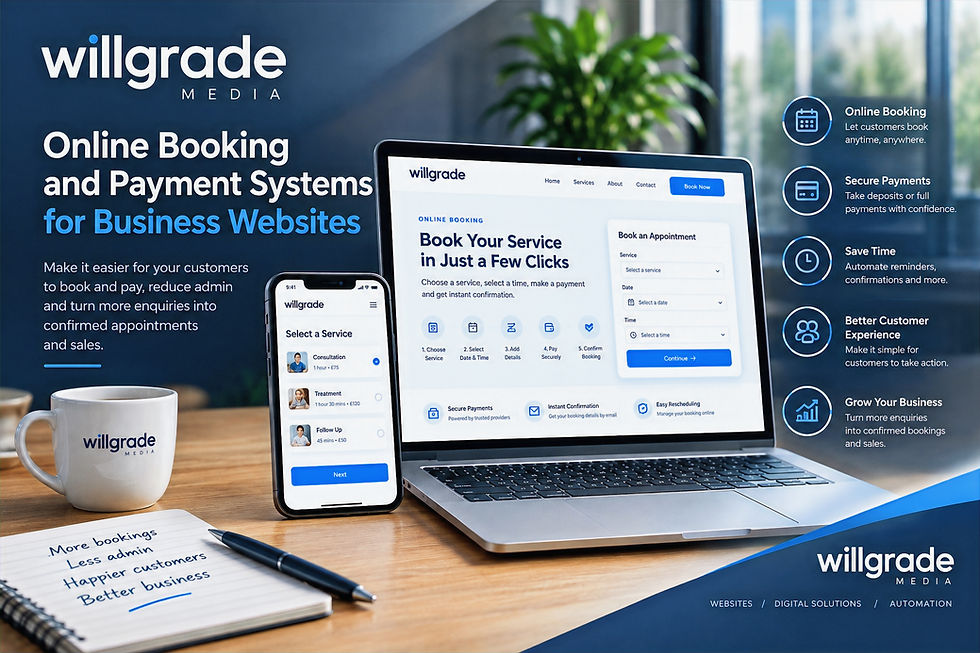
For many businesses, getting customers to make an enquiry is only the first step. The real challenge is turning that enquiry into a confirmed appointment, booking or sale without creating unnecessary work for the business.
A well-designed website can do much more than provide information. With the right online booking and payment systems, customers can choose a service, select a suitable time, provide their details and, where appropriate, make a payment without having to exchange multiple emails or phone calls.
For businesses that rely on appointments, consultations, classes, services or deposits, this can make a significant difference to how efficiently the website works.
Why Do Businesses Need Online Booking?
Traditional booking processes often involve a customer getting in touch, asking about availability, waiting for a response and then arranging a suitable time.
That process can work, but it creates unnecessary administration.
If a business receives several enquiries every day, responding to messages, checking availability and manually confirming appointments can quickly become time-consuming.
An online booking system can move much of this process onto the website.
Customers can see the services available, choose an appropriate time and submit their booking themselves.
This means the website becomes part of the booking process rather than simply directing people to contact the business.
Customers Can Book When It Suits Them
One of the biggest advantages of online booking is convenience.
Customers do not necessarily want to contact a business during normal office hours. They may be researching services in the evening, during a lunch break or at the weekend.
An online booking system allows them to take action whenever they are ready.
Instead of seeing a phone number and thinking, "I'll call tomorrow," they can potentially complete the booking immediately.
That can remove a significant barrier between someone showing interest and becoming a customer.
Online Booking Can Reduce Administration
Manual bookings create repetitive tasks.
A business may need to:
Respond to enquiries
Check availability
Suggest appointment times
Collect customer information
Confirm the appointment
Send reminders
Take deposits or payments
Update calendars
Keep records of bookings
A properly configured booking system can automate many of these steps.
That does not mean every part of the customer relationship needs to be automated. It simply means that repetitive administrative work can be handled by the website where it makes sense to do so.
Online Payments Can Make the Process Easier
Booking is only part of the process for many businesses.
A customer may also need to pay a deposit, pay for a consultation, purchase a service or make a full payment at the time of booking.
Adding online payments to the booking journey can remove another step.
Instead of confirming an appointment and then arranging payment separately, the website can potentially allow the customer to complete both actions as part of the same process.
This can be particularly useful for businesses where missed appointments or unpaid bookings create a financial problem.
Deposits Can Help Protect Appointments
Some businesses do not need to collect the full price when a booking is made.
A deposit may be more appropriate.
For example, a business could require a £25 deposit to secure an appointment, with the remaining balance paid later.
An online booking and payment system can be designed around this type of process.
The important point is that the system should reflect the way the business actually operates rather than forcing the business to change its processes unnecessarily.
Online Booking Can Improve the Customer Experience
A professional website should make it easy for visitors to understand what to do next.
If someone wants to book a service, they should not have to search through several pages to find out how.
A clear booking journey might look like this:
Choose a service
View available times
Select a date
Enter contact details
Confirm the booking
Make a payment or deposit if required
Receive confirmation
The simpler the process is, the less opportunity there is for a customer to abandon it.
What Can an Online Booking System Include?
The exact functionality depends on the business.
An online booking system might include:
Different services
Different service durations
Staff or team members
Availability calendars
Appointment limits
Customer information
Booking confirmations
Automated reminders
Deposits
Online payments
Cancellation policies
Rescheduling
Calendar integration
A simple business may only need basic appointment booking.
Another business may need a much more detailed system.
Online Booking Is Not Just for Appointments
Although appointment-based businesses are an obvious example, online booking can be useful in many different industries.
It could be used for:
Consultations
Training sessions
Classes
Workshops
Beauty treatments
Fitness sessions
Photography sessions
Music lessons
Business meetings
Demonstrations
Events
Equipment hire
The underlying principle is the same: allowing customers to choose and confirm something directly through the website.
What About Businesses That Sell Services?
Service businesses can benefit particularly strongly from combining booking with payment.
Imagine a customer visiting a website looking for a specific service.
Instead of simply reading about the service and filling out a generic contact form, they could potentially:
Choose the service
Select a package
Choose a date
Provide their details
Pay a deposit
Receive confirmation
The website becomes a working part of the sales process.
Online Booking and E-commerce Can Work Together
Some businesses need both booking functionality and e-commerce.
For example, a business could sell physical products while also allowing customers to book services.
A website might therefore contain:
An online shop
Service pages
Booking functionality
Online payments
Customer enquiries
Automated emails
This is where good website planning becomes important.
The different parts of the website should feel like one connected customer journey rather than several unrelated systems.
Can Booking Systems Connect With Other Website Features?
They can also form part of a wider digital solution.
For example, a website could combine online booking with:
Automated quote calculations
Customer enquiry forms
Email notifications
CRM systems
Customer accounts
Payment processing
Calendar systems
Automated follow-up messages
The aim is not to add technology simply because it is available.
The aim is to connect the right features so that they solve a genuine business problem.
What Happens When a Business Has More Complex Requirements?
Not every business can use a simple off-the-shelf booking system.
A company might have unusual pricing, multiple stages in its booking process, different customer types or services that require additional information before confirmation.
In those situations, the website may need a more bespoke approach.
For example, a customer could complete a form that collects specific requirements before being shown an appropriate service or booking option.
This is where bespoke digital solutions can become useful.
The website can be designed around the business rather than forcing the business into a standard process.
When Is a Standard Booking System Enough?
A standard booking system may be perfectly suitable when the business has relatively straightforward requirements.
If customers simply need to select a service, choose an available time and pay, there may be no reason to build something more complicated.
The important thing is to understand the process before deciding what technology is required.
More functionality does not automatically mean a better website.
When Should You Consider a Bespoke Booking Solution?
A bespoke solution may be worth considering when the standard booking process does not fit the business.
For example:
Services have complex pricing
Different customers require different options
Several systems need to communicate
Customers need to provide detailed information
Quotes need to be calculated before booking
Booking availability depends on other factors
The business has a unique workflow
Existing systems need to be connected
In these situations, a customised digital solution can potentially remove work rather than simply adding another piece of software.
Security and Customer Information Matter
Booking and payment systems also need to be designed responsibly.
A website may collect names, email addresses, telephone numbers, appointment information and payment-related data.
Businesses should therefore consider privacy, security and the way customer information is stored and processed.
Payment information should normally be handled through an appropriate payment provider rather than being unnecessarily collected or stored directly by the website.
The booking process should also make it clear what information is being collected and why.
Don't Make the Booking Process Too Complicated
There is a balance between functionality and simplicity.
A booking system with too many questions, unnecessary steps or confusing options can make the customer experience worse.
Before adding another feature, ask whether it actually helps the customer or the business.
A good booking system should make the process easier, not turn a simple appointment into a complicated digital journey.
How Online Booking Can Help a Small Business
Small businesses often have limited time and resources.
The owner may be responsible for sales, customer service, administration and actually delivering the service.
Reducing repetitive booking and payment tasks can therefore have a practical impact.
Even saving a few minutes on each booking can add up when a business handles dozens of appointments or enquiries each week.
The website can handle routine tasks while the business concentrates on customers and the work itself.
What Should You Consider Before Adding Online Booking?
Before building or adding a booking system, consider:
What exactly is being booked?
How long does each service take?
Who provides the service?
When is the business available?
Do customers need to pay upfront?
Is a deposit required?
What happens if someone cancels?
Do customers need reminders?
What information needs to be collected?
Does the booking need to connect to another system?
Answering these questions first can prevent problems later.
Online Booking Should Fit Your Business
There is no single booking system that is right for every business.
A simple service may need a straightforward booking calendar.
Another business may need booking, payments, customer accounts, automated quotes and other digital tools working together.
The right solution depends on the business, its customers and the process it needs to support.
What Should an Online Booking and Payment System Achieve?
The goal should be simple.
An online booking and payment system should make it easier for customers to take action while reducing unnecessary administration for the business.
It should help answer questions such as:
Can customers book without contacting us first?
Can customers pay securely?
Can we reduce repetitive administration?
Can we manage availability more efficiently?
Can customers receive confirmation automatically?
Does the system work properly on mobile devices?
Does it fit the way our business actually operates?
If the answer to these questions is yes, the website is doing more than simply looking professional. It is actively helping the business operate.
What Should You Do Next?
If your business currently manages bookings through phone calls, emails or messages, it may be worth looking at how much time that process takes.
You may not need a complicated system.
You may simply need a better booking journey built into your existing website.
For businesses with more specific requirements, online booking can also be combined with payments, automated quotes, customer forms and other bespoke digital solutions.
At Willgrade Media, we build and improve business websites with practical functionality in mind, including online booking, payments, automation and bespoke digital solutions.
If your existing website could be doing more, you can start with a free website audit or look at our online booking website design service. You can also get an instant online quote for your project.
Comments